
Applied Behavior Analysis (ABA) is the most extensively researched intervention for autism and related developmental differences. It breaks skills into small, teachable steps and uses positive reinforcement to build communication, social interaction, attention and independence.
Tender Twig delivers ABA in Gulshan, Dhaka, to children aged 2 to 12, through internationally certified IBT therapists working under IBA supervision. Every program is individually designed, data-tracked, and aimed at one outcome: readiness for a mainstream classroom.
This page covers everything we do. Most families arrive somewhere in the middle of it: a child who is not talking yet, a child whose behavior is making school impossible, a child who has just been offered a place and needs to hold onto it. Use the menu below to jump to the part that matches your child, or read it through if you are still working out where you stand.
Four Stages, One Direction
Most children move through these stages. Some only need one. We will tell you which after the assessment, and we will tell you honestly if the answer is none of them.
Early Intervention
Early intervention is ABA delivered during the years when a child’s brain is most responsive to learning language and social behavior, roughly ages two to six. Starting inside that window gives a child the longest possible runway to build communication before school begins.
Who this is for: Children aged 2 to 6 who are not yet talking, not responding to their name, not playing alongside other children, or who have lost words or skills they previously had.
The single most common thing we hear from parents in Dhaka is that they were told to wait. Wait until he is three. Wait until she starts school. Boys talk late. Waiting is the one thing that cannot be undone later. Every month spent waiting is a month of learning the child does not get back.
Early intervention does not mean drilling a two-year-old at a desk. At this age almost everything is taught through play, because play is how young children learn and because a child who enjoys the session works harder in it. A therapist might spend twenty minutes on the floor with bubbles, and in that twenty minutes be systematically teaching eye contact, requesting, turn-taking and tolerating the end of an activity.
What separates this from ordinary playgroup is the structure underneath it. Every target is defined before the session, scored during it, and reviewed against the last one. If a skill is not moving after a set number of sessions, the teaching method changes. We do not simply keep doing the same thing more loudly.
A week in the program
A typical early intervention week for a three-year-old on fifteen hours looks like this. Nobody else in Dhaka publishes their schedule, and you are entitled to know what you are paying for before you commit.
- ·Five sessions of three hours, morning or afternoon, at our Gulshan center.
- ·Each session splits into structured teaching blocks, floor play, a snack or self-care routine, and a group or peer segment where appropriate.
- ·One parent coaching slot a week, so what worked in the room gets repeated at home.
- ·Data reviewed weekly by the supervising IBA; the written program updated as targets are met.
What we work on
- Functional communication: asking for what they want
- Play and imitation skills
- Joint attention and responding to their name
- Behavior regulation and tolerating “no”
- Pre-academic foundations: matching, sorting, sitting
- Self-care routines and independence
- Ages
- 2 to 6 years
- Session
- 2 to 3 hours
- Typical intensity
- 10 to 20 hrs / week
One-to-One Therapy
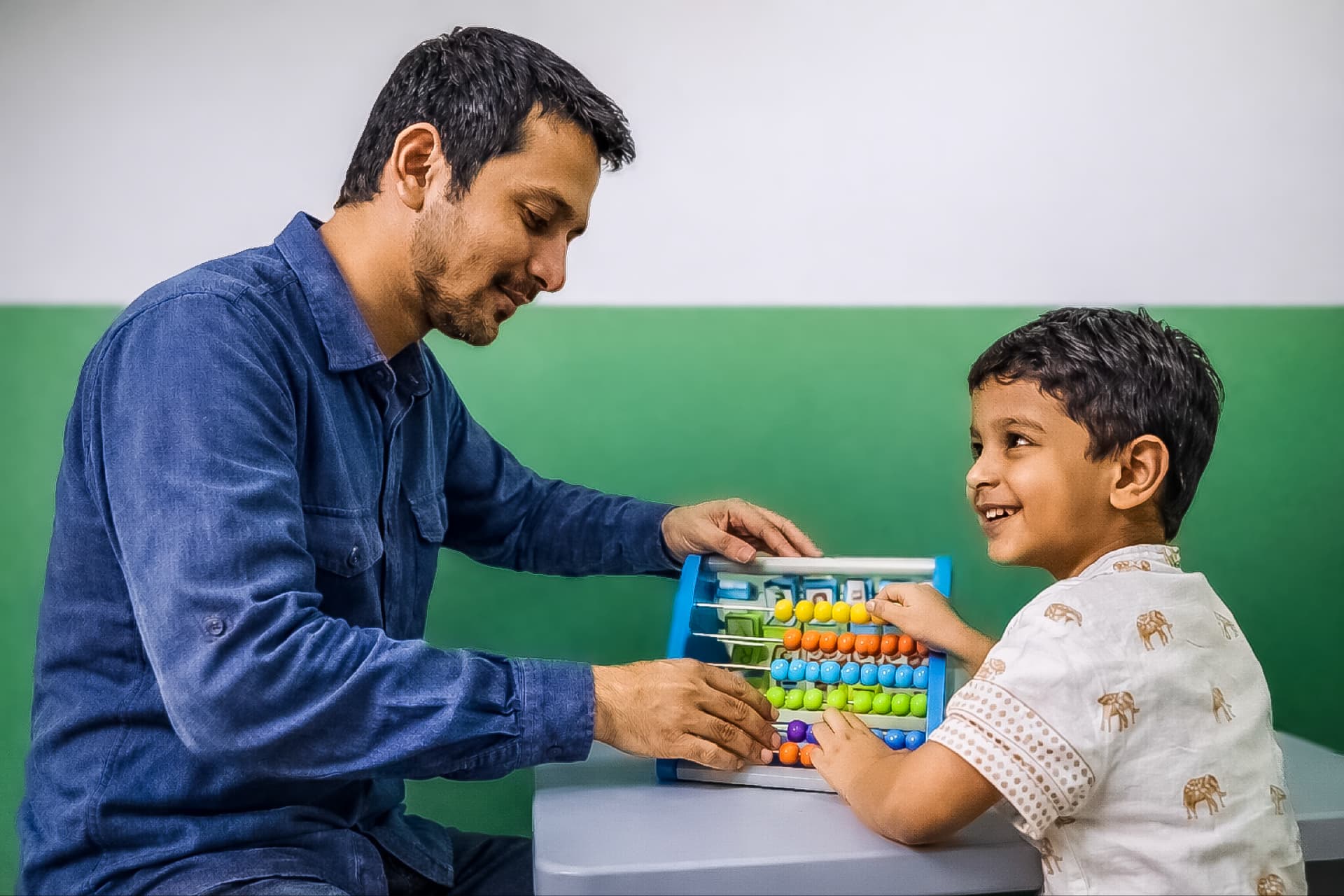
One-to-one ABA pairs your child with a single dedicated therapist for the whole session, so every minute is spent on your child’s own goals rather than shared across a group.
Who this is for: Children of any age in our range who need concentrated work on specific skills, or whose behavior or attention makes group learning ineffective for now.
What sixty minutes actually contains
“One hour of therapy” is not a useful description, so here is the real breakdown. Roughly the first five minutes go on pairing: the therapist re-establishes rapport so the child wants to be there. The next thirty-five to forty minutes alternate between structured teaching trials and looser natural-environment teaching, deliberately mixed so the child does not simply learn to perform at a table. Around ten minutes go to a generalization activity, practicing the same skill somewhere else, with different materials or a different person. The final five minutes are handover: what happened, what moved, what to try at home tonight.
What IBT and IBA actually mean
Every therapy center in Dhaka lists credentials, and almost none of them explain what the letters mean. You are being asked to trust an acronym, so here it is plainly.
IBT stands for International Behavior Technician, the therapist who is in the room with your child, trained and certified to deliver the program and record the data. IBA stands for International Behavior Analyst, the senior clinician who assesses your child, designs the program, reads the data and decides what changes. Supervision is the point: it means clinical decisions about your child are made by a qualified analyst, not improvised by whoever is on shift.
If any center cannot tell you who supervises your child’s program and how often that person reviews it, that is the question to keep asking.
What we work on
- Expressive and receptive language
- Social interaction and play with peers
- Attention span and task completion
- Daily living skills: dressing, eating, toileting
- Following instructions and transitions
- Flexibility and coping with change
- Ages
- 2 to 12 years
- Session
- 60 to 180 minutes
- Typical intensity
- 3 to 20 hrs / week
Behavior Support
Behavior support works out why a challenging behavior is happening and teaches the child a more effective way to get the same result. In ABA, behavior is treated as communication rather than misbehavior.
Who this is for: Children whose meltdowns, aggression, self-injury, running off or refusal are limiting family life, school placement, or the child’s own safety.
A child who screams when the tablet is taken away, and gets it back, has learned something extremely effective. A child who hits when asked to stop playing, and the demand is dropped, has also learned something effective. Neither child is being difficult. Both have found a strategy that works, and the job is not to punish the strategy but to make a better one work faster.
So we start with a functional assessment: structured observation of when the behavior happens, what comes immediately before it, and what it achieves. Only then do we write a plan, because a plan written without knowing the function of a behavior is guesswork. The plan always has two halves: reducing what needs to stop, and teaching a replacement skill that gets the child the same thing more easily.
How we practice: stated plainly
ABA has a contested reputation among some autistic adults internationally, and parents who research properly will find that discussion. It deserves a direct answer rather than silence.
- We use no aversives. No punishment procedures, and nothing withheld that a child needs: not food, not the toilet, not comfort.
- We work with assent. A child who is distressed or declining is telling us something, and we stop and adjust rather than push through.
- We do not target behaviors that are simply autistic, harmless and self-regulating. Stimming that hurts nobody is not a problem to be fixed.
- Goals are chosen for the child’s benefit, such as safety, communication and independence, not for adult convenience.
What we work on
- Meltdowns and prolonged distress
- Aggression toward others
- Self-injurious behavior
- Refusal and non-compliance
- Running off or leaving the room
- Rigidity around routines and transitions
- Starts with
- Functional assessment
- Produces
- Written behavior plan
- Delivered
- Center, school or both
School Readiness
School readiness is the set of skills a child needs in order to learn in a group, not the academic content itself. Most Dhaka schools expect a five-year-old to sit for around twenty minutes, follow a two-step instruction given to the whole class, use the toilet independently, ask for help, and move between activities without distress.
Who this is for: Children approaching nursery or reception, or children who have already tried school and found it did not work yet.
Almost every parent we meet has the same goal, even when they have not said it out loud: they want their child in a normal classroom, with normal children, doing normal school. That goal is reasonable and for many children it is achievable. It is also the thing that most therapy in Dhaka is not explicitly organized around, which is why we organize ours around it.
Notice what is not on the readiness checklist above. Nothing about letters, numbers, or reading. Schools teach those. What schools cannot teach, and what they assume arrived with the child, is the ability to learn in a room with twenty-five other people and one adult. That is the gap this stage closes, and it is why a child can be bright and still not be ready.
The work moves deliberately from one-to-one toward group. A child who can follow an instruction from their own therapist practices following it from a therapist they know less well, then in a pair, then in a small group, then with a delay before the reward, then with the sort of background noise a real classroom has. Readiness that only exists in a quiet room with a familiar adult is not readiness.
Approaching a Dhaka school when your child has a diagnosis
This is the part no one in Bangladesh writes down, and the part parents ask us about most. There is no single right answer, but there are patterns worth knowing.
- 1.Shortlist before you apply. Schools in Dhaka vary enormously in how they handle a child who needs support, far more than their prospectuses suggest. Ask other parents, and ask us; we know which schools have taken children well and which have not.
- 2.Disclose early, and disclose in person. Concealing a diagnosis to get through admission almost always backfires within a term, and it costs you the goodwill you will need later. A meeting where you explain what your child needs and what support is already in place lands very differently from a form.
- 3.Arrive with a plan, not a problem. “My child has autism” invites a no. “My child has autism, here is her current skill profile, here is the support we provide, and here is the therapist who would be in your classroom” invites a conversation.
- 4.Ask what happens when it is hard. Any school will say yes on a good day. Ask specifically: who is called, what is the procedure, and under what circumstances would you ask him to leave? The answer tells you everything.
- 5.Let us do the talking where it helps. We speak to schools on behalf of families as part of the program, at no extra charge. A clinician explaining a behavior plan carries weight that a parent, however well informed, often is not given.
The readiness checklist
- Sitting and attending for 15 to 20 minutes
- Following instructions given to a whole group
- Waiting, turn-taking and sharing materials
- Transitioning between activities on cue
- Independent toileting, eating and belongings
- Asking an adult for help when stuck
- Ages
- Typically 4 to 7 years
- Format
- Individual + small group
- Runs
- 3 to 12 months before entry
Classroom Support & Shadow Teaching
A shadow teacher is a trained therapist who sits with your child in their actual classroom, helping them access the lesson the teacher is already giving. A shadow is not a private tutor, not a minder, and not a permanent arrangement.
Who this is for: Children who have a school place and need support to keep it, or children whose school has asked for support as a condition of staying.
The role is widely misunderstood in Dhaka, and the misunderstanding causes real damage. A shadow who does the child’s work for them produces a child who cannot work. A shadow who sits silently produces nothing at all. A shadow who becomes the only adult the child will respond to has created a new problem to solve later.
Done properly, the shadow’s job is to become unnecessary. They prompt the child to attend to the teacher rather than to themselves, they fade the prompt as soon as the child can manage without it, and they hand the strategies to the classroom teacher so the support outlives the placement. We also run training sessions for the teaching staff, because a teacher who understands why a child behaves as they do is worth more than an extra adult in the room.
Fading, and how we know when to stop
Support that never reduces is not support, it is dependence. We set exit criteria at the start and review them at every progress meeting. Typically we begin reducing when a child can:
- Follow whole-class instructions without an individual prompt, consistently across a set number of days.
- Ask the class teacher, not the shadow, for help.
- Manage break and transition times without incident.
- Hold behavior within the plan while the shadow is at a distance, then out of the room.
What we work on
- Staying on task during lessons
- Responding to the class teacher, not just the shadow
- Managing transitions and unstructured time
- Interacting with classmates
- Reducing disruption to the class
- Building independence from adult prompting
- Delivered
- In your child’s school
- Includes
- Teacher training
- Goal
- Planned fading
Parent Coaching
A skill that only appears in the therapy room has not been learned. It has been trained. Parent coaching is how skills move from our center into your home, and it is included in every program at no additional cost.
Who this is for: Every family we work with. This is not an optional add-on and we do not run programs without it.
Fifteen hours a week of therapy is a lot of therapy. It is also less than fifteen percent of your child’s waking week. The other eighty-five percent is you, which means the fastest program in the world will stall if what happens at the center and what happens at home pull in opposite directions.
Coaching sessions are practical rather than theoretical. We watch a real situation, usually the one you find hardest, and work on it together: what to say, when to say nothing, when to step in and when to wait. Parents are also given the same data their therapist keeps, so you can see whether what you are doing at home is working rather than guessing.
We should also say the obvious thing that centers tend to avoid. This is hard, most parents feel they are failing at it periodically, and that feeling is not evidence that you are. Support for the family is part of the work, not a courtesy attached to it.
What we work on
- Running the same strategies at home
- Responding consistently to challenging behavior
- Creating opportunities for your child to communicate
- Managing routines: meals, bedtime, outings
- Knowing what to ignore and what to act on
- Handling family and social pressure
- Frequency
- Weekly or fortnightly
- Format
- In person or online
- Cost
- Included in the fee
Assessment & Progress Tracking
Every program begins with a structured assessment, usually two to three sessions, that produces a written baseline of what your child can currently do across communication, social, play, self-care and pre-academic skills.
Who this is for: Every child, before any therapy begins. The assessment is also how we tell you honestly whether we are the right service for your child at all.
Goals are written so that they can be proved or disproved. “Improve communication” is not a goal, it is a hope. “Independently requests eight preferred items using a full word, across three different people, on four consecutive sessions” is a goal: you can look at it and know whether it happened.
Every target is scored every session, so progress is a line on a chart rather than an impression. You see that chart. If a goal has not moved in a set number of sessions the supervising analyst changes the teaching approach, and we tell you that we have changed it and why.
Formal reviews happen every three months, in person, with the data in front of you. We use those meetings to retire goals that are met, add new ones, and revisit the number of hours, including reducing them. A program that only ever grows is a business model, not a clinical plan.
What you get
- Written baseline skill profile
- Individualized, measurable goals
- Data recorded every session
- Weekly review by the supervising IBA
- Scheduled progress meetings with parents
- Written reports for schools when needed
- Assessment
- 2 to 3 sessions
- Data
- Every session
- Formal review
- Every 3 months
We only do ABA, and here is when we will tell you to go elsewhere
Other centers in Dhaka offer six or eight therapies under one roof. We offer one. That is a deliberate choice: we would rather do a single thing to a standard we can defend than sell you whatever we happen to have available.
The honest consequence is that ABA is not the answer to everything, and there are children we should not take. If any of the following describes your child, the right first step is somewhere other than here, and we will say so at the assessment rather than after you have paid for a term.
- A child whose only difficulty is producing speech sounds, with age-appropriate social skills and behavior, usually needs a speech and language therapist, not us.
- Significant motor delay, feeding difficulty, or sensory processing needs are the territory of an occupational therapist.
- Regression, seizures, or an unexplained loss of skills needs a pediatric neurologist before any therapy begins.
- An older child or adolescent whose main difficulty is anxiety, mood or trauma is better served by a clinical psychologist.
- Where a child needs ABA and something else, we will say that too, and work alongside the other professional rather than competing with them.
We keep referral contacts for each of these in Dhaka and will give them to you whether or not you become a client. A center that does one thing and refers out honestly is a safer bet than a center that finds every child needs exactly what it sells.
What Every Program Includes
These are part of the fee. None of them is billed separately, and none of them is reserved for a higher tier.
- Initial skills assessmentTwo to three sessions, with a written baseline report you keep.
- Individualized program planWritten goals across every relevant skill area, reviewed as your child progresses.
- Parent coachingStructured sessions so strategies work at home, not only at the center.
- Session-by-session dataEvery target is scored every session. You see the same data we do.
- Scheduled progress reviewsA sit-down review of goals, data and next steps at set intervals.
- School liaisonWe speak to your child’s school or prospective school when it helps them.
ABA Therapy in Dhaka: Frequently Asked Questions
The questions parents ask us most often, answered directly.
Applied Behavior Analysis (ABA) is the most extensively researched intervention for autism. It breaks skills into small, teachable steps and uses positive reinforcement to build communication, social interaction, attention and independence. Decades of studies support it, though outcomes vary from child to child.
As early as a concern is identified. The years between two and six are when children learn language and social behavior most readily, so starting in that window gives the longest runway before school. That said, we work with children up to twelve and older children still make meaningful progress.
It depends on age and goals. Young children in early intervention typically need 10 to 20 hours a week to build foundational skills. Older children working on specific targets, such as classroom behavior, often do well on 3 to 6 hours. We recommend a number after the assessment and revise it as your child progresses.
Most children work with us for one to three years, with hours reducing over time. The goal is always to fade support, not to keep a child in therapy indefinitely. We set exit criteria at the start so everyone knows what finishing looks like.
ABA teaches skills and changes behavior across every area of a child’s life. Speech therapy focuses specifically on producing speech sounds, language and swallowing. Occupational therapy focuses on motor skills, sensory processing and daily-living tasks. Many children benefit from more than one, and they work well alongside each other.
Behavioral intervention is well established for ADHD as well as autism. For a child with ADHD the targets shift toward sustained attention, impulse control, following multi-step instructions and completing tasks independently, especially in the classroom.
No. We can assess and begin working on skills without a diagnosis. A formal diagnosis is often useful for school admission and other services, and we can point you toward pediatric neurologists and clinical psychologists in Dhaka who provide one.
Cost depends on the number of hours your child needs each week, which we recommend after the assessment. Our fees page sets out how pricing works, what is included at no extra charge, and the questions worth asking any center before you pay.
Our therapists hold International Behavior Technician (IBT) certification and work under the supervision of an International Behavior Analyst (IBA). Supervision means a qualified analyst designs and reviews your child’s program rather than leaving decisions to the therapist in the room.
Most therapy runs at our Gulshan center, where we control the learning environment. Classroom support is delivered in your child’s own school. Home programs are handled through parent coaching rather than therapist-led home sessions.